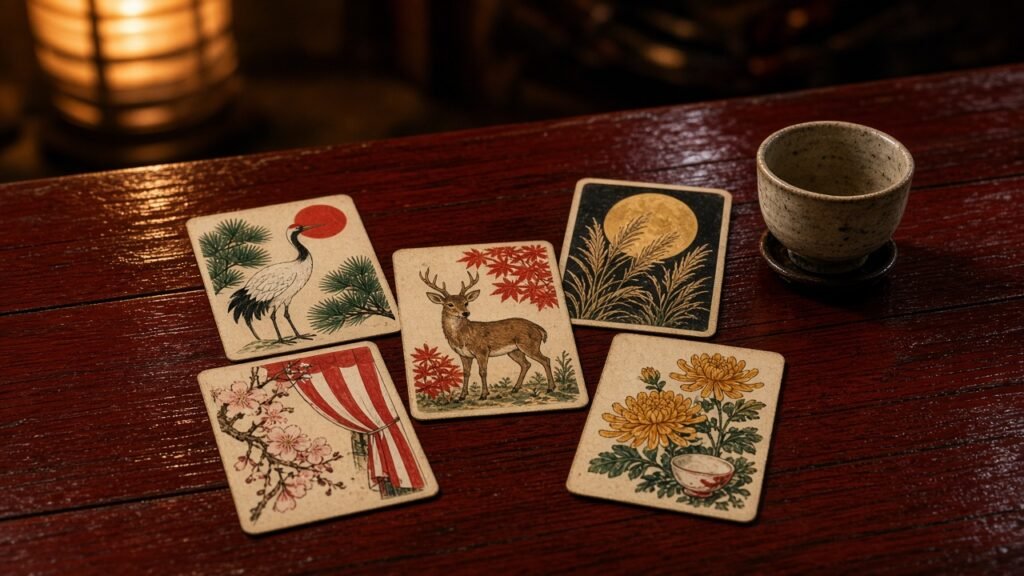
Did you know that the word yakuza is usually traced back to a losing hand in a Japanese card game? The game is Oicho-Kabu, played with hanafuda flower cards or dedicated kabufuda cards. Draw an 8, a 9 and a 3 (ya-ku-za), and the total is 20. In Oicho-Kabu only the last digit counts, so that hand scores zero, the worst result possible. From “a worthless hand” came “a worthless person”, and eventually the name for Japan’s gambling underworld.
This guide explains what Oicho-Kabu is, the traditional names for each number, how a typical round is played, the special dealer hands, the real odds of drawing a perfect nine, and how the game connects to the yakuza etymology. One note before we start: betting money on games is illegal gambling under Japan’s Penal Code, so treat this as cultural history and play for points only.
What Is Oicho-Kabu?
Oicho-Kabu is a simple comparing game. You add up the values of your cards and keep only the last digit. A 7 and a 5 make 12, which scores 2. A 9 and a 10 make 19, which scores 9. The best possible score is 9, called kabu, and the second best is 8, called oicho. The game’s name simply joins those two words.
If that sounds like baccarat, you are right: both games reward the hand closest to nine. Oicho-Kabu is generally thought to descend from card games brought to Japan by Portuguese traders in the 16th century. “Oicho” is widely said to come from the Portuguese oito (eight), and “pin” (one) is also traced to Portuguese.
Which Cards Are Used?
The most common way to play is with the 40 hanafuda cards from January (pine) to October (maple). Hanafuda has four cards per month, so each month number becomes the card value from 1 to 10. The November (willow) and December (paulownia) cards are removed. You can read more about the deck itself in our guide to hanafuda and Koi-Koi.
There is also a dedicated deck called kabufuda, which shows the numbers 1 to 10 four times each. Either way, you end up with the same 40-card structure.
The Traditional Number Names
Part of Oicho-Kabu’s charm is the slang name for every final digit. Names vary by region, but these are the best known:
- 1: Pin (also called inketsu)
- 2: Nizō
- 3: Santa (or sanzun)
- 4: Yotsuya
- 5: Goke
- 6: Roppō
- 7: Naki (or shichiken)
- 8: Oicho
- 9: Kabu (the best)
- 0: Buta (“pig”, the worst)
A hand that totals 10 or 20 ends in zero and is called buta. That is the hand behind the word yakuza.
How to Play Oicho-Kabu: A Typical Round
House rules differ a lot, but this is a widely described version of the game.
1. Choose the Dealer
One player becomes the oya (dealer or banker). Everyone else is a ko (player). Players do not compete with each other; each one plays against the dealer.
2. Lay Out the Cards and Place Chips
The dealer lays several cards face up on the table (four is the classic layout) and deals one card face down to themselves. Players put their chips or points on the card they want to back.
3. Deal a Second Card and Decide on a Third
Each pile and the dealer receive a second card. Players then decide whether to draw a third card. A common rule is: you must draw on 3 or less, you may not draw on 7 or more, and 4 to 6 is your choice. Three cards is the maximum.
4. Compare With the Dealer
All cards are revealed and the score closest to 9 wins. In most rule sets, ties go to the dealer, which gives the banker a built-in edge.
Special Hands: Shippin, Kuppin and Arashi
Besides the ordinary scores, Oicho-Kabu has a few special combinations:
- Shippin (4 and 1): the first two cards are a 4 and a 1. The total is only 5, but in many rule sets a dealer holding shippin beats the players.
- Kuppin (9 and 1): a 9 and a 1, which totals zero, yet some rules treat it as a winning dealer hand.
- Arashi (“storm”): three cards of the same number. In most versions this is the strongest hand of all.
Because these hands vary from table to table, agree on them before you start.
What Are the Odds of Drawing Kabu?
From a 40-card deck (four each of 1 to 10) there are 780 possible two-card hands. A final digit of 9 comes from 1+8, 2+7, 3+6, 4+5 or 9+10. Each pair has 4 × 4 = 16 combinations, for 80 in total, so the chance of a two-card kabu is about 10.3%.
Buta (zero) comes from 1+9, 2+8, 3+7 and 4+6 (16 combinations each) plus a pair of 5s or a pair of 10s (6 combinations each), for 76 hands, or about 9.7%. In other words, the perfect hand and the worthless hand turn up almost equally often. For more Japanese games of chance, compare these odds with Chinchirorin and Cho-Han.
Oicho-Kabu and the Origin of the Word “Yakuza”
The famous losing hand is 8, 9 and 3. In Japanese those numbers can be read ya, ku and za. Add them up and you get 20, which scores zero. Having drawn three cards and still ending with nothing, the player holds the most useless hand in the game.
That is why “yakuza” first meant something worthless, and later a person who lived by gambling instead of honest work. The Edo-period bakuto who ran gambling dens are said to have adopted the label with a certain self-mocking pride. You can learn more about them in Bakuto and Tekiya: The Two Historical Roots of the Yakuza. Keep in mind that word origins are rarely certain, and other theories exist, but the Oicho-Kabu explanation is the most widely cited.
Oicho-Kabu Today and Japanese Law
Oicho-Kabu is a staple of yakuza films, manga and video games, where it often appears in gambling-den scenes. In real life, Japan’s Penal Code makes gambling a crime (Article 185), with heavier penalties for habitual gambling (Article 186). There is an exception for betting things meant for momentary entertainment, but cash should not be treated as such. If you play with family or friends, use chips or points.
Frequently Asked Questions
What do “oicho” and “kabu” mean?
Oicho is the name for a score of 8 and kabu is the name for 9. Oicho is widely believed to come from the Portuguese word for eight, oito.
Which hanafuda cards are used in Oicho-Kabu?
Usually the 40 cards from January to October. The November and December cards are taken out, and each month number becomes the card value.
Who wins a tie?
In most versions the dealer wins ties, although some groups treat a tie as a draw.
Does “yakuza” really come from Oicho-Kabu?
The 8-9-3 losing hand is the most common explanation for the word, but etymologists note that other theories exist.
Can I play Oicho-Kabu for money in Japan?
No. Betting money is illegal gambling under the Penal Code. Play for points or chips instead.