
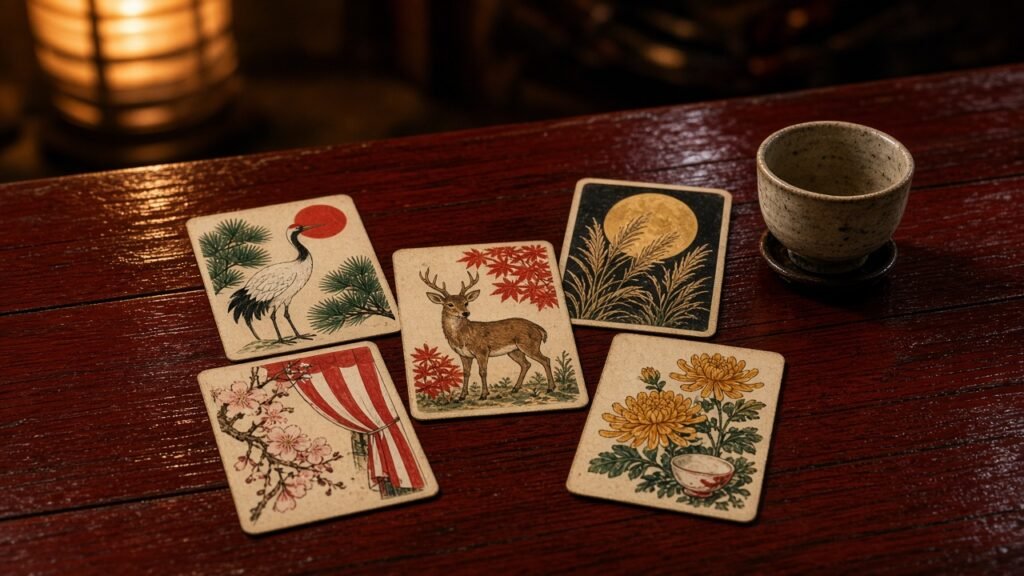
With their pine trees and cranes, cherry blossoms and curtains, and deer beneath red maple leaves, hanafuda cards are among the most beautiful games Japan has produced. Many families still play them at New Year, and they appear in anime and video games all over the world. Yet these “flower cards” also have a long history tied to Edo-period gambling, and they even feature in the most popular explanation of where the word “yakuza” comes from. This guide covers the history of hanafuda, how the 48-card deck works, and the basic rules of Koi-Koi, the most popular hanafuda game.
What Is Hanafuda?
Hanafuda (花札, literally “flower cards”) is a traditional Japanese card deck in which each month of the year is represented by a flower or plant. The deck has 48 cards divided into 12 suits of four cards each. Instead of numbers, every card shows a seasonal plant, often with a bird, an animal, a poetry ribbon or another object, and the picture decides how many points the card is worth.
Because there are no numbers, hanafuda can feel confusing at first. Once you learn the twelve monthly flowers, though, the game becomes a small journey through the Japanese seasons.
A Short History of Hanafuda
Cards Arrive from Portugal
Playing cards reached Japan with Portuguese traders in the mid-16th century. The Portuguese deck had 48 cards in four suits of 12 ranks. Japanese craftsmen copied it during the Tensho era (1573–1592), producing what are now called Tensho karuta. The Japanese word karuta itself is usually traced to the Portuguese carta, meaning card.
Bans and Disguised Designs
Card games quickly became a tool for gambling, so the Tokugawa shogunate banned them again and again, including a ban on Tensho karuta in 1648. Each time, new decks with different designs and rules appeared to get around the law. Hanafuda’s flower-and-bird imagery, with no visible numbers, is widely seen as a product of this long cat-and-mouse game with the authorities.
The earliest known reference to hana awase, the forerunner of hanafuda, dates from 1816, when it was recorded as a banned gambling tool. Over time the deck settled into today’s standard of 12 months with four cards each.
The Meiji Era and Nintendo
After the Meiji Restoration, selling cards became legal again and hanafuda turned into a common household pastime. In 1889, Fusajiro Yamauchi founded a company in Kyoto to make hand-crafted hanafuda. That company was Nintendo, and it still sells hanafuda and kabufuda decks today.
Hanafuda and the Word “Yakuza”
Since hanafuda were used in gambling dens from the Edo period onward, they are closely linked to the culture of the bakuto, Japan’s professional gamblers. The best-known example is the explanation for the word yakuza. In the hanafuda game oicho-kabu, the goal is a total whose last digit is as close to nine as possible. A hand of eight, nine and three adds up to 20, whose last digit is zero, making it the worst possible hand. “Ya-ku-za” (8-9-3) came to mean something worthless, and later a name for gamblers and outcasts.
If you want to learn about another custom from the same world, read our guide to yubitsume, the yakuza finger-cutting ritual. Today, of course, hanafuda is a family game, and playing for money is illegal in Japan.
The 48 Cards: Months, Flowers and Card Types
The Twelve Monthly Flowers
- January: Pine (crane and sun)
- February: Plum blossom (bush warbler)
- March: Cherry blossom (curtain)
- April: Wisteria (cuckoo)
- May: Iris (eight-plank bridge)
- June: Peony (butterflies)
- July: Bush clover (boar)
- August: Susuki grass (full moon, geese)
- September: Chrysanthemum (sake cup)
- October: Maple (deer)
- November: Willow (poet Ono no Michikaze, swallow)
- December: Paulownia (phoenix)
The Four Card Types
- Brights (hikari, 20 points): five cards, the crane, the curtain, the moon, the rain man (Ono no Michikaze) and the phoenix.
- Animals (tane, 10 points): cards with animals or objects such as the boar, deer, butterflies and sake cup.
- Ribbons (tanzaku, 5 points): cards showing red or blue poetry ribbons.
- Chaff (kasu, 1 point): cards showing only the plant.
How to Play Koi-Koi
Setup and Turns
Koi-Koi is a two-player game and the most popular way to play hanafuda. Deal eight cards to each player and eight face up on the table. The rest form a face-down draw pile.
- Play one card from your hand. If a table card shares its month, capture both; if not, leave your card on the table.
- Flip the top card of the draw pile and do the same.
- Keep taking turns until someone completes a scoring combination, called a yaku.
Call “Koi-Koi” or Stop
When you form a yaku, you choose: stop the round and score, or call “koi-koi” (roughly “come on”) and keep playing for a bigger score. If your opponent completes a yaku before you stop, you can lose your points. That gamble is what gives the game its name and its tension.
Common Yaku
Point values differ between house rules, but typical examples are:
- Goko (Five Brights): all five brights, around 10 points.
- Shiko (Four Brights): four brights without the rain man, around 8 points.
- Ame-shiko (Rainy Four Brights): four brights including the rain man, around 7 points.
- Sanko (Three Brights): three brights without the rain man, around 5 points.
- Ino-shika-cho: boar, deer and butterflies, around 5 points.
- Akatan and Aotan: three red poetry ribbons, or three blue ribbons, around 5 points each.
- Hanami-zake and Tsukimi-zake: the sake cup with the cherry curtain or with the moon.
- Tane, Tan and Kasu: five animals, five ribbons or ten chaff, from 1 point.
The more detailed English rules on Wikipedia’s Koi-Koi page are a handy reference once you know the basics.
Tips for Beginners
- Learn the twelve flowers first so you can spot matching months instantly.
- Aim for easy combinations such as ino-shika-cho, akatan and aotan in your first games.
- Watch what your opponent captures to guess which yaku they are chasing.
- Mobile apps and console games are a good way to practise the rules.
For more articles on Japanese culture and yakuza history, visit our English home page.
Frequently Asked Questions
How many cards are in a hanafuda deck?
There are 48 cards, four for each of the 12 months. Some commercial decks also include spare or blank cards.
How is hanafuda different from Western playing cards?
Western cards use numbered ranks in four suits. Hanafuda uses 12 suits shown as flowers, has no numbers, and gives each card a point value based on its picture.
Did Nintendo invent hanafuda?
No. Hanafuda existed long before Nintendo. Nintendo was founded in 1889 as a hanafuda maker and still produces the cards.
How many people can play Koi-Koi?
Koi-Koi is a two-player game. Groups of three or more usually play other games such as hana awase or hachi-hachi.
Is it legal to gamble with hanafuda in Japan?
No. Gambling for money is prohibited under Japan’s Penal Code, so hanafuda should be played for points only.
Conclusion
Hanafuda began as a Japanese copy of Portuguese playing cards, changed shape under centuries of gambling bans, and became one of Japan’s most elegant traditional games. Its ties to the bakuto and the 8-9-3 story give it a colourful past, but today it is simply a fun game for families and friends. Learn the twelve flowers and a few yaku, and you are ready for your first round of Koi-Koi.
