When people talk about where the yakuza came from, two words always come up: bakuto and tekiya. Both were occupational groups that emerged during Japan’s Edo period (1603–1868), and many modern organised crime groups have traced their own lineage back to one or the other. Yet the two were very different in how they started and how they made a living. This article explains who the bakuto and tekiya were, and how they came to be linked with the word “yakuza”, following the story through history.
Where the Word “Yakuza” Comes From
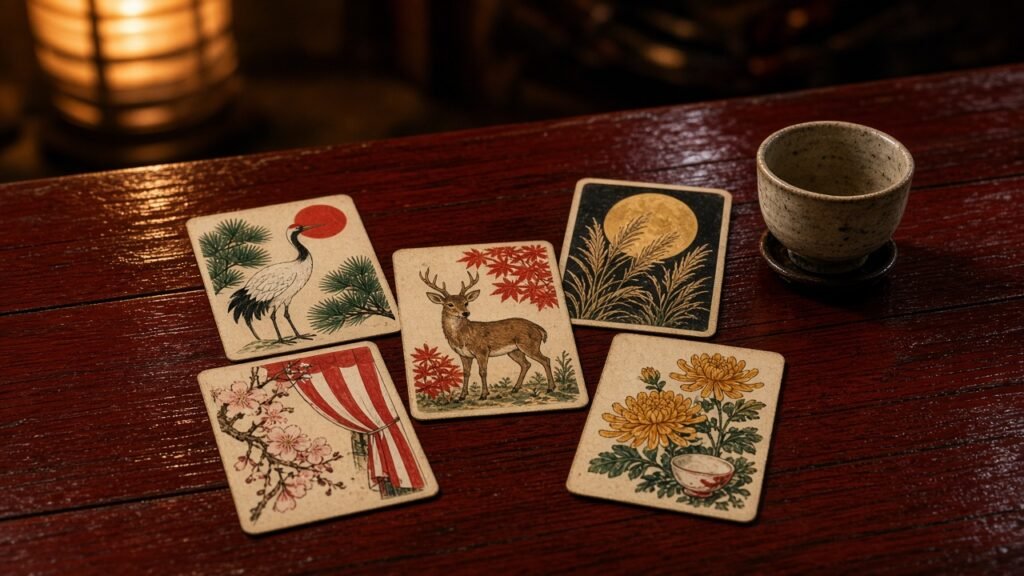
A widely shared explanation says the word yakuza itself comes from gambling. In the card game oicho-kabu, played with hanafuda cards, the combination eight, nine and three adds up to twenty, which counts as the worst possible hand, worth zero. “Ya-ku-za” (8-9-3) came to mean something useless, and by extension an outsider or misfit. Even at the level of the word, the close tie to gambling is clear.
Bakuto: The People Who Ran the Gambling Dens
Gambling in the Edo Period
Bakuto were people who made their living from gambling. The Tokugawa shogunate officially banned gambling, but in practice gambling dens operated in many places. According to historical accounts, they were often held on the grounds of temples and shrines, or in the servants’ quarters (chugen-beya) of samurai residences – places where the town magistrates found it hard to reach. The best-known game was cho-han, in which players bet on whether the total of two dice would be even or odd. The house provided the venue and took a commission known as terasen, literally “temple money”.
The Bond Between Boss and Followers
Running a gambling den meant attracting customers, settling disputes and staying out of sight of officials. Out of these needs grew a kind of artificial family, with a boss, the oyabun, at the top. The boss looked after his followers, the kobun, and the followers gave him their loyalty. This relationship became the backbone of later yakuza organisations. Gambling-based groups called their territory “shima”, meaning island, and they placed great weight on the right to open gambling dens within it.
Tekiya: The Stallholders Who Kept Festivals Running
A Merchant Group That Honoured Shinno
The tekiya, on the other hand, were groups of merchants who set up stalls at festivals and temple fairs. Also called yashi, they sold medicines, daily goods, sweets and toys as they travelled. In the tekiya world it was customary to honour Shinno, a legendary Chinese figure regarded as a god of farming and medicine, as a guardian deity, and this worship served as a symbol of unity among members.
The Job of Allocating Stall Spaces
At a temple fair, deciding which stall goes where – known as bashowari – matters a great deal. Managing this was the boss’s role. In return for collecting a fee from stallholders, he took responsibility for settling arguments and keeping order. Most tekiya were ordinary traders, but the power struggles over the right to a location encouraged organisation and a strong sense of territory.
Comparing Bakuto and Tekiya
- Livelihood: bakuto focused on running gambling games, while tekiya focused on selling goods at stalls.
- Where they worked: bakuto operated in the closed space of the gambling den, tekiya in the open space of festivals and markets.
- Guardian deity: the tekiya had their own culture of worshipping Shinno.
- Etiquette: both groups had distinctive greetings and slang, and both stressed courtesy among members.
Changes in the Modern Era
From the Meiji period onward, as Japan built a modern police system, both bakuto and tekiya increasingly became targets of enforcement. Then, in the chaotic years after the Second World War, a new kind of street gang known as gurentai appeared and expanded its influence, often around the black markets. Researchers frequently explain that these three strands – bakuto, tekiya and gurentai – together formed the family tree of today’s organised crime groups.
It is important to stress that most of the people running stalls at festivals today are ordinary business owners with no connection to such groups. Efforts to exclude organised crime have spread across Japan, and more and more festivals now ask stallholders to sign written pledges. The historical tekiya should not be casually equated with present-day street vendors.
Their Influence on Culture
The culture of the bakuto and tekiya remains vivid in film and theatre. The formal jingi greeting, the duty and compassion between boss and followers, and the wandering life of the travelling gambler have been portrayed again and again in period dramas and ninkyo films. If you want to learn more about yakuza rituals, see our article on the history and meaning of yubitsume. You can also browse every article from the Yakuza Gang home page.
FAQ
Which came first, the bakuto or the tekiya?
Both already existed during the Edo period, and historians generally consider it difficult to say for certain which came first. How far each developed also varied by region and era.
Were all tekiya yakuza?
No. Most tekiya were merchants who earned their living from stalls, and many had nothing to do with organised crime.
What does “shima” mean?
It is a term from the gamblers’ world meaning a territory in which a group held the right to run gambling dens. It is still known today as slang for turf.
Are festival stalls in Japan safe today?
At most festivals the organisers manage the stallholders, and events are run so that ordinary visitors and tourists can enjoy them with peace of mind. You can shop and eat as normal.