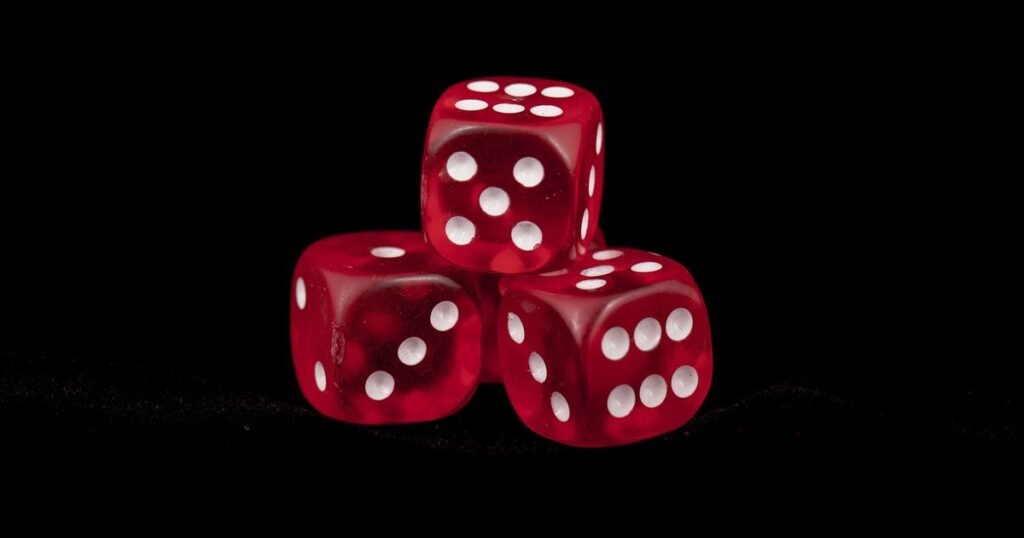
All you need is three dice and a rice bowl. That is the whole kit for chinchirorin, one of Japan’s best-known dice games. Many people outside Japan first saw it in the manga and anime Kaiji, where the hero faces off against the scheming foreman Otsuki in an underground labour camp. The name is said to imitate the bright ringing sound the dice make as they spin around a ceramic bowl. In this guide you will learn the rules of chinchirorin, the hands from strongest to weakest, how the banker and players take turns, and the real odds behind three dice.
Note: this article explains a traditional game and its place in Japanese culture. Gambling for money is illegal in Japan, so play for points or snacks with friends and family.
What Is Chinchirorin?
Chinchirorin (often shortened to chinchiro) is a game in which each player throws three dice into a bowl and tries to make the strongest combination, called a yaku (hand). It has long been a casual game among ordinary people because it needs almost no equipment and the rules take only a few minutes to learn. That makes it a fun party game or a travel game.
It is quite different from cho-han, the classic gambling-house game where a dealer shakes two dice in a cup and players bet on whether the total is even or odd. In cho-han you guess; in chinchirorin you roll for yourself and try to build a winning hand.
What You Need
- Three standard six-sided dice of the same size
- A rice bowl or deep bowl so the dice do not fly out
- Chips, coins from a board game, or a notepad to keep score
- Two or more players (four to six is the most fun)
How to Play Chinchirorin: Basic Rules
One player is the banker, called the oya (parent), and everyone else is a ko (child). House rules vary a lot from group to group, but a typical round goes like this:
- Choose the banker. For example, everyone rolls once and the best hand becomes the first banker.
- Players place bets. Before the banker rolls, each player declares how many points they are betting.
- The banker rolls. The banker throws all three dice into the bowl. If no hand appears, they may roll again, up to three times.
- Instant results. If the banker rolls a very strong hand, they win from every player immediately. If they roll a losing hand, they pay every player.
- Players roll. If the banker made an ordinary point, each player rolls in turn (up to three times) and compares their hand with the banker’s.
- Settle and rotate. Pay out the points, then pass the bank according to your rules, such as after each lap or whenever the banker loses.
What Is “Shonben”?
If a die bounces out of the bowl, Japanese players jokingly call it shonben (slang for “pee”). Under most rules it counts as an instant loss or as no hand. Roll gently and let the dice run around the inside of the bowl.
Chinchirorin Hands Ranked
Here are the hands from strongest to weakest. Payouts depend on house rules, so treat the multipliers below as common examples rather than fixed rules.
| Hand | Dice | What it means | Typical payout |
|---|---|---|---|
| Pinzoro | 1-1-1 | The strongest hand | 5x |
| Zorome (Arashi) | 2-2-2 to 6-6-6 | Three of a kind | 3x |
| Shigoro | 4-5-6 | The straight 4-5-6 | 2x |
| Me (point 6 down to 1) | e.g. 3-3-5 = point 5 | A pair plus one odd die; the odd die is your point | 1x |
| Menashi (no hand) | e.g. 1-3-6 | No hand after three rolls | Lose |
| Hifumi | 1-2-3 | The worst hand | Pay 2x |
How Points Work
The most common result is a point, or me. When two dice match, the third die is your score. So 2-2-6 is a point of 6, the best point, while 5-5-1 is a point of 1, the weakest. The value of the pair itself does not matter.
Banker Instant-Win and Instant-Loss Rules
Under common rules, if the banker rolls pinzoro, any three of a kind, shigoro or a point of 6, all players lose without rolling. If the banker rolls hifumi, a point of 1 or no hand, all players win without rolling. Only when the banker makes a point of 2 to 5 do the players roll. A tie with the banker’s point is usually a draw.
Chinchirorin Odds: The Math of Three Dice
Three dice produce 6 x 6 x 6 = 216 equally likely outcomes. From that, we can work out the chance of each hand on a single roll.
| Hand | Outcomes | Chance per roll |
|---|---|---|
| Pinzoro (1-1-1) | 1 | about 0.46% |
| Other triples (2-6) | 5 | about 2.31% |
| Shigoro (4-5-6) | 6 | about 2.78% |
| Hifumi (1-2-3) | 6 | about 2.78% |
| Any point (1 to 6) | 90 | about 41.67% |
| One specific point (e.g. 6) | 15 | about 6.94% |
| No hand | 108 | 50% |
So each roll has exactly a 50% chance of producing some hand (including hifumi). The chance of failing all three rolls and ending with no hand is 0.5 x 0.5 x 0.5 = 12.5%, which means you make a hand within three rolls about 87.5% of the time.
Pinzoro appears only once in 216 rolls on average, which is why it pays the most. Interestingly, shigoro and hifumi each have six outcomes, so the best straight and the worst hand are exactly as likely as each other.
Kaiji and the Famous 4-5-6 Dice
Chinchirorin reached a huge audience through Nobuyuki Fukumoto’s manga Gambling Apocalypse: Kaiji (the Tobaku Hakairoku Kaiji arc). In the story, foreman Otsuki keeps winning by secretly using loaded dice that show only 4, 5 and 6, so he rolls strong hands far more often than fair dice allow. Kaiji’s breakthrough comes from noticing that the results do not match the odds.
That storyline is often quoted as a lesson: knowing the probabilities protects you from being cheated. When you play, use ordinary store-bought dice and let everyone check them before the game.
A Short History of the Game
Dice games have a long history in Japan. In the Edo period, gambling houses run by bakuto (professional gamblers) were known for dice games such as cho-han. Chinchirorin needs no dealer, cup or special mat, only a bowl and dice, which is probably why it spread so widely among ordinary people. Written records of its exact origin are scarce, and the most common explanation of the name is the sound of the dice.
If you are curious about the culture of Japan’s old gamblers, read our guides to hanafuda and koi-koi and the sakazuki sake cup ceremony.
Tips for Playing Chinchirorin Safely
- Do not play for money. Japan’s Penal Code includes a gambling offence (Penal Code on e-Gov, Japanese). Use points, chips or snacks.
- Agree on house rules first. Settle payouts, banker rotation and shonben rules before you start.
- Pick a sturdy bowl. Ceramic sounds best but can chip; plastic or wooden bowls work fine.
- Use it to teach probability. Building the odds table together is a great maths lesson for kids.
FAQ
What is the best hand in chinchirorin?
Pinzoro (1-1-1) is usually the strongest hand and often pays five times the bet, followed by other triples and then shigoro (4-5-6).
What is the worst hand?
Hifumi (1-2-3) is the worst hand, and the player who rolls it usually pays double.
How many times can you roll?
Normally up to three times per turn. If no hand appears after three rolls, the result is “no hand” (menashi).
Is shigoro stronger than three of a kind?
Under most rules, three of a kind (zorome) beats shigoro, but some groups use different rankings.
Is chinchirorin legal to play?
Playing for fun without betting money or valuables is fine. Betting money can count as gambling under Japanese law.
Conclusion
Chinchirorin is a simple but surprisingly deep Japanese dice game: three dice, one bowl, and a ranking of hands from pinzoro down to hifumi. Learn how points work and you can play in minutes. Understand the 216 outcomes and you will see why pinzoro pays so well and why Kaiji’s 4-5-6 dice were such an effective cheat. Grab a bowl, keep it friendly, and enjoy the sound that gave the game its name.